

I recently spoke with a couple who wants to sell their home. Their realtor told them the market was a little soft but added that interest rates were likely to come down this year. The suggestion was that falling rates would boost home prices. That’s a common assumption, but it left me wondering whether it is always true.
Two key questions here are worth asking. First, do mortgage rates always go down when the Federal Reserve cuts interest rates? And second, even if mortgage rates decline, should we expect home values to rise as a result?
To help answer these questions, I spoke with Eric Steuernagle, owner of Fairground Real Estate in Great Barrington (MA) and a housing expert. I also looked back at decades of data on interest rates and home prices.
Fed Funds and Mortgage Rates
The Fed directly controls a short-term interest rate known as the federal funds rate. This rate is what banks charge one another for overnight loans, so it’s quite different than the rate you’d pay on a 30-year mortgage. Mortgage rates are tied more closely to long-term rates, which are influenced by inflation, investor expectations, housing demand, and even global events.
Still, historical data show that short-term rates and long-term rates generally move in the same direction. Since the late 1980s, the average spread between the Fed’s target rate and the 30-year mortgage rate has been about three percentage points (see Figure 1). So, if the Fed’s rate lands near 3.5 percent, mortgage rates might settle at around 6.5 percent – roughly where they are today.
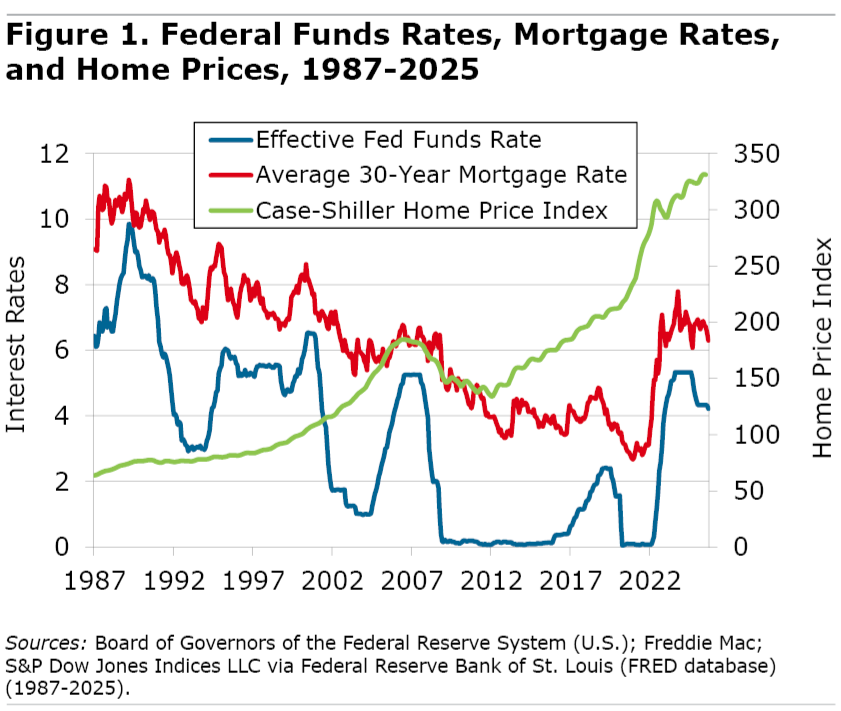
This is one reason Steuernagle is skeptical that housing will become dramatically more affordable. He says that home prices would likely increase “if you think [mortgage] interest rates are going back to 2.75 percent [where they were at the beginning of the pandemic], but that may have been once in a lifetime.”
The Fed cut the fed funds rate by 0.25 percentage points each in September and October. The market still expects one more 0.25-percentage-point cut this year, although it’s uncertain. The goal is to stimulate the economy as signs of labor market weakness emerge. So, while Fed cuts may bring mortgage rates down slightly, there’s no guarantee they will fall by a huge amount.
The historical data suggest that longer-term interest rates, including mortgage rates, may decline slightly when the Fed lowers the overnight lending rate. But to Steuernagle’s point, mortgage rates between 5 and 6 percent are much less enticing for buyers than the 3 percent rates we saw a few years ago.
Mortgage Rates and Home Values
Even if mortgage rates do decline, the bigger question is what that means for home prices. In theory, lower mortgage rates make monthly payments more affordable for buyers, which should support higher home values. But history shows the connection is far from consistent.
Consider four major rate-cutting cycles in recent decades:
- Early 1990s (Gulf War recession): Mortgage rates fell from about 10 percent to 7 percent between 1990 and 1993. Yet home values barely budged, rising just 2 percent over four years.
- Early 2000s (dot-com bust): Rates fell from around 8 percent to 6 percent between 1999 and 2003. This time, home prices surged, rising by about 40 percent nationally.
- 2007-2008 (global financial crisis): Rates declined from about 6 percent to 5 percent, but home prices cratered, falling 17 percent as the housing market collapsed.
- 2019-2020 (COVID-19 pandemic): Mortgage rates dropped from roughly 4.5 percent to a record-low 2.7 percent. Home prices spiked 14 percent and kept climbing afterward.
The takeaway from these episodes is that economic factors like unemployment, stock market performance, and financial crises can overwhelm the impact of falling rates. It’s also important to remember that housing markets are highly local. Taxes, job opportunities, school quality, and community factors all shape affordability and demand in ways that national interest rates can’t fully explain. In fact, Steuernagle says, taxes and other local factors can be more relevant in assessing affordability.
Bottom Line on Home Values
It is reasonable to expect mortgage rates to fall in response to Fed rate cuts, but that doesn’t mean home prices will automatically climb. If anything, broader economic trends and local market dynamics will play a bigger role than Fed policy alone.
Luke Delorme, CFP® is Director of Financial Planning at Tableaux Wealth in Great Barrington, MA (www.tableauxwealth.com), reachable at luke@tableauxwealth.com. To stay current on the Squared Away blog, join our free email list.
This blog post is for informational and educational purposes only and should not be considered financial advice. Consult a qualified professional for advice specific to your situation.